Overview
The results of a planning analysis give a first indication of required pump capacities for planning purposes. The analysis does not consider any pump curves or system heads.
The planning process is an iterative one. Starting with the diameters defined in the system data, the diameters of all inadequate pipes are iteratively increased, according to the diameters defined in the cost function tables, until the design criteria are met.
Design Criteria
The velocity in a rising main is calculated by:
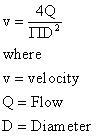
Rising Mains are governed by 1design criteria:
•Maximum Design Velocity
The diameter is increased iteratively until the velocity in the pipe at maximum flow is less than the design maximum velocity.
There is a further design criteria for rising mains:
•Minimum Design Velocity
The minimum design velocity should be exceeded at least once a day. Thus for variable speed pumps the maximum flow should ensure that the minimum velocity is exceeded and continuous pumps should pump at a flow where the minimum velocity is exceeded.
In the planning analysis there are 2 options to increase the velocity in the rising mains:
oIncrease the pump capacity, thereby increasing the flow in the rising main
oDecrease the diameter of the rising main
Decreasing the diameter in the rising main may not be a practical solution and increasing the pump capacity has an influence on the downstream system. It is therefore not possible for Sewsan to determine which of these options should be used.
Therefore rising mains are only designed on their maximum design velocity. The user is warned if the minimum design velocity is not met.
Design of Pipes Parallel to Existing Pipes
The diameter of the parallel pipe is calculated in the following manner:
•The maximum flow (based on the design maximum velocity) of the existing pipe is determined.
•The flow in the parallel pipe is the flow exceeding the maximum flow in the existing pipe.
•The minimum required diameter of the parallel pipe is determined using the parallel pipe flow and the design maximum velocity.
•The applicable diameter in the rising mains cost table is then selected and the velocity in the parallel pipe for that diameter is calculated (using the parallel pipe flow).
•If the parallel pipe velocity is less than the design minimum velocity the flow in the parallel pipe is recalculated using the design minimum velocity and the determined parallel diameter. This is the minimum allowable flow in the parallel pipe.
•The flow in the existing pipe is recalculated with the new parallel flow and the velocity in the existing pipe is checked against the design minimum velocity.
•If the total inflow is not sufficient to supply both the existing and parallel pipes at the design minimum velocity there is no parallel solution.
Variable speed pumps
For variable speed pumps it is assumed that the minimum velocity is exceeded once a day which is sufficient for scour purposes. The variable speed rising mains are therefore designed on the maximum flow into the pumps.